St George's CE Primary School
Early Reading and Phonics
St George's Phonics and Early Reading Policy
Learning to read and discovering the joy of books
We learn to read so that we can read to learn. Learning to read is a right for all children and gives them a pathway to a more successful future.
At St George’s, our staff and governing body hold the teaching of reading in the highest regard. As well as the teaching of the skills needed to decode and understand books, we aim to encourage and nurture a love of reading. Reading takes us to new lands, makes us interact with new characters, helps us understand how others are feeling and gives us information we need on subjects that interest us.
Our intention is that every child rapidly develops the skills and knowledge to start reading. We see reading as the foundation to learning across all subjects and a child cannot fulfil their potential without becoming a competent reader. Additionally, we are determined that every child will enjoy books and develop a love of reading not only to secure their educational achievements but also to unlock the joy and fulfilment that reading can bring to ones life.
Early readers
Early Readers are pupils at the early stages of their journey in learning to read. Our Early Readers use phonic decoding as their reading approach, identifying the sounds in words and blending them to read the words. We track children’s progress in reading carefully and children of any age can be identified as Early Readers. Our Early Readers read books carefully matched to their phonics knowledge and are supported to rapidly gain the phonics knowledge and skills to become fluent independent readers.
Phonics
Phonics is one of our passions across the school! We run sessions daily in EYFS and year 1 with keep up and catch up sessions happening across the school to enable all children to develop as fluent and confident readers.
We use the DFE validated Little Wandle Revised programme to ensure a swift and successful start for all of our Early Readers. Phonics is taught daily in EYFS and Year 1 . Children in Reception and KS1 also enjoy three group reading practise sessions a week reading books together. Our books are carefully matched to the progression of our phonics scheme ensuring that they are fully decodable for each child. Our practise sessions are a key step in developing children as enthusiastic and independent readers.
Phonics and Early Reading
At St George's, we have a positive reading culture in school to promote a love for reading, which is a skill which underpins all learning. It is essential that our approach to teaching phonics and reading is accessible to all learners, regardless of background.
Phonics (reading and spelling)
At St. George's, we believe that all our children can become fluent readers and writers. This is why we teach reading through Little Wandle Letters and Sounds Revised, which is a systematic and synthetic phonics programme. We start teaching phonics in Nursery and follow the Little Wandle Letters and Sounds Revised progression, which ensures children build on their growing knowledge of the alphabetic code, mastering phonics to read and spell as they move through school. As a result, all our children are able to tackle any unfamiliar words as they read.
At St. George's, we also model the application of the alphabetic code through phonics in shared reading and writing, both inside and outside of the phonics lesson and across the curriculum. We have a strong focus on language development for our children because we know that speaking and listening are crucial skills for reading and writing in all subjects.
Comprehension
At St. George's, we value reading as a crucial life skill. By the time children leave us, they read confidently for meaning and regularly enjoy reading for pleasure. Our readers are equipped with the tools to tackle unfamiliar vocabulary. We encourage our children to see themselves as readers for both pleasure and purpose.
Foundations for phonics in Nursery
- We provide a balance of child-led and adult-led experiences for all children that meet the curriculum expectations for ‘Communication and language’ and ‘Literacy’. These include:
- sharing high-quality stories and poems
- learning a range of nursery rhymes and action rhymes
- activities that develop focused listening and attention, including oral blending
- attention to high-quality language.
- We ensure Nursery children are well prepared to begin learning grapheme-phoneme correspondences (GPCs) and blending in Reception.
Daily phonics lessons in Reception and Year 1
- We teach phonics for 30 minutes a day. Each Friday, we review the week’s teaching to help children become fluent readers.
- We follow the ‘Little Wandle Letters and Sounds Revised expectations of progress‘.
Comprehension
- At St. George's, we value reading as a crucial life skill. By the time children leave us, they read confidently for meaning and regularly enjoy reading for pleasure. Our readers are equipped with the tools to tackle unfamiliar vocabulary. We encourage our children to see themselves as readers for both pleasure and purpose.
Foundations for phonics in Nursery
- We provide a balance of child-led and adult-led experiences for all children that meet the curriculum expectations for ‘Communication and language’ and ‘Literacy’. These include:
- sharing high-quality stories and poems
- learning a range of nursery rhymes and action rhymes
- activities that develop focused listening and attention, including oral blending
- attention to high-quality language.
- We ensure Nursery children are well prepared to begin learning grapheme-phoneme correspondences (GPCs) and blending in Reception.
Daily phonics lessons in Reception and Year 1
- We teach phonics for 30 minutes a day. In Reception, we build from 10-minute lessons, with additional daily oral blending games, to the full-length lesson as quickly as possible. Each Friday, we review the week’s teaching to help children become fluent readers.
- Children make a strong start in Reception: teaching begins in the Autumn term.
- We follow the ‘Little Wandle Letters and Sounds Revised expectations of progress‘.
- Children in Reception are taught to read and spell words using Phase 2 and 3 GPCs, and words with adjacent consonants (Phase 4) with fluency and accuracy.
- Children in Year 1 review Phase 3 and 4 and are taught to read and spell words using Phase 5 GPCs with fluency and accuracy.
Daily Keep-up/Catch-up lessons
- Any child who needs additional support has daily Keep-up or catch-up sessions. These sessions match the structure of class teaching, and use the same procedures, resources and mantras, but in smaller steps with more repetition, so that every child secures their learning.
-
Teaching reading: Reading practice sessions
When learning phonics children learn how to associate letter sounds (phonemes) with their corresponding letter pattern (grapheme). Children learn how to blend clusters of these letter patterns (such as ‘ay’ digraph; ‘air’ trigraph) to form words. This is known as decoding. At the same time, their knowledge of the most commonly seen words (high frequency words) increases. Children begin to broaden their awareness of words which do not follow the general grapheme ‘rules’ (tricky words). Children learn alternative letter patterns for known sounds (such as ‘oa’ also being represented as o, o-e, ou, oe, and ‘ow’). Throughout this process, children read age-appropriate, phonically decodable books with lots of opportunities to apply the sounds they have learnt. They are taught to answer questions related to the text and encouraged to query the action or content of the text whilst reading. This continues to develop with age and experience and children learn to establish a greater understanding of their reading with our St. George's reading skills by being able to explain new vocabulary, retrieve information, say what is likely to happen next, make inferences.
- We teach children to read through reading practice sessions. These:
- are taught to small groups of approximately six children
- use books matched to the children’s secure phonic knowledge.
- Each reading practice session has a clear focus:
- decoding
- prosody: teaching children to read with understanding and expression
- comprehension: teaching children to understand the text
Home reading
- A decodable reading book is taken home to ensure success is shared with the family.
- Reading for pleasure library books also go home for parents to share and read to children.
Additional reading support for vulnerable children
- Children in Reception and Year 1 who are receiving additional phonics Keep-up sessions read their reading practice book to an adult daily.
Ensuring reading for pleasure
‘Reading for pleasure is the single most important indicator of a child’s success.’ (OECD 2002)
‘The will influences the skill and vice versa.’ (OECD 2010)
We value reading for pleasure highly and work hard as a school to grow our Reading for Pleasure pedagogy.
- We read to children every day. We choose these books carefully as we want children to experience a wide range of books, including books that reflect the children at St. George's and our local community as well as books that open windows into other worlds and cultures.
- Every classroom has an inviting book corner that encourages a love for reading. We curate these books and talk about them to entice children to read a wide range of books.
- In Nursery/Reception, children have access to the reading corner every day in their free flow time and the books are continually refreshed.
- Children from Reception onwards have a home reading record. The parent/carer records comments to share with the adults in school.
- As the children progress through the school, they are encouraged to write their own comments and keep a list of the books/authors that they have read.
- Each class visits the school library every week.
- Children across the school have regular opportunities to engage with a wide range of Reading for Pleasure events (book cafes, Sharing A Teacher’s book, book fairs, author visits and workshops, national events and reading for pleasure days).
Assessment
- Assessment is used to monitor progress and to identify any child needing additional support as soon as they need it.
- Assessment for learning is used:
- daily within class to identify children needing Keep-up support
- weekly in the Review lesson to assess gaps, address these immediately and secure fluency of GPCs, words and spellings.
- Summative assessment is used:
- every six weeks to assess progress, to identify gaps in learning that need to be addressed, to identify any children needing additional support and to plan the Keep-up support that they need.
- The Little Wandle Letters and Sounds Revised placement assessment is used:
- with any child new to the school to quickly identify any gaps in their phonic knowledge and plan provide appropriate extra teaching.
Statutory assessment
- Children in Year 1 sit the Phonics screening check. Any child not passing the check re-sits it in Year 2.
Parents
 We value our parents and the vital role you play in supporting children to learn to read and develop a lifelong love of books. We ask parents of children in Reception and Key Stage 1 to hear their child read every day alongside reading stories to your child as well. Please click the Little Wandle icon (right) to access a range of helpful resources to support you to help your child.
We aim to share information and tips regularly. If we can help or guide you further in any way, please don’t hesitate to get in touch with us.
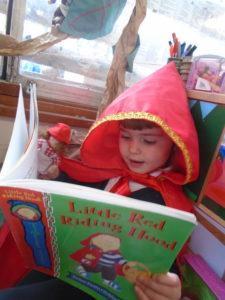
We have been enjoying reading traditional tales in the EYFS classroom. Can you spot a character you recognise?